
Job-specific English
English for Cashiers
Till English is fast and numerical. You greet, you confirm the total, and you catch a “wait — I have a coupon” before the drawer closes.
The job
What is a cashier?
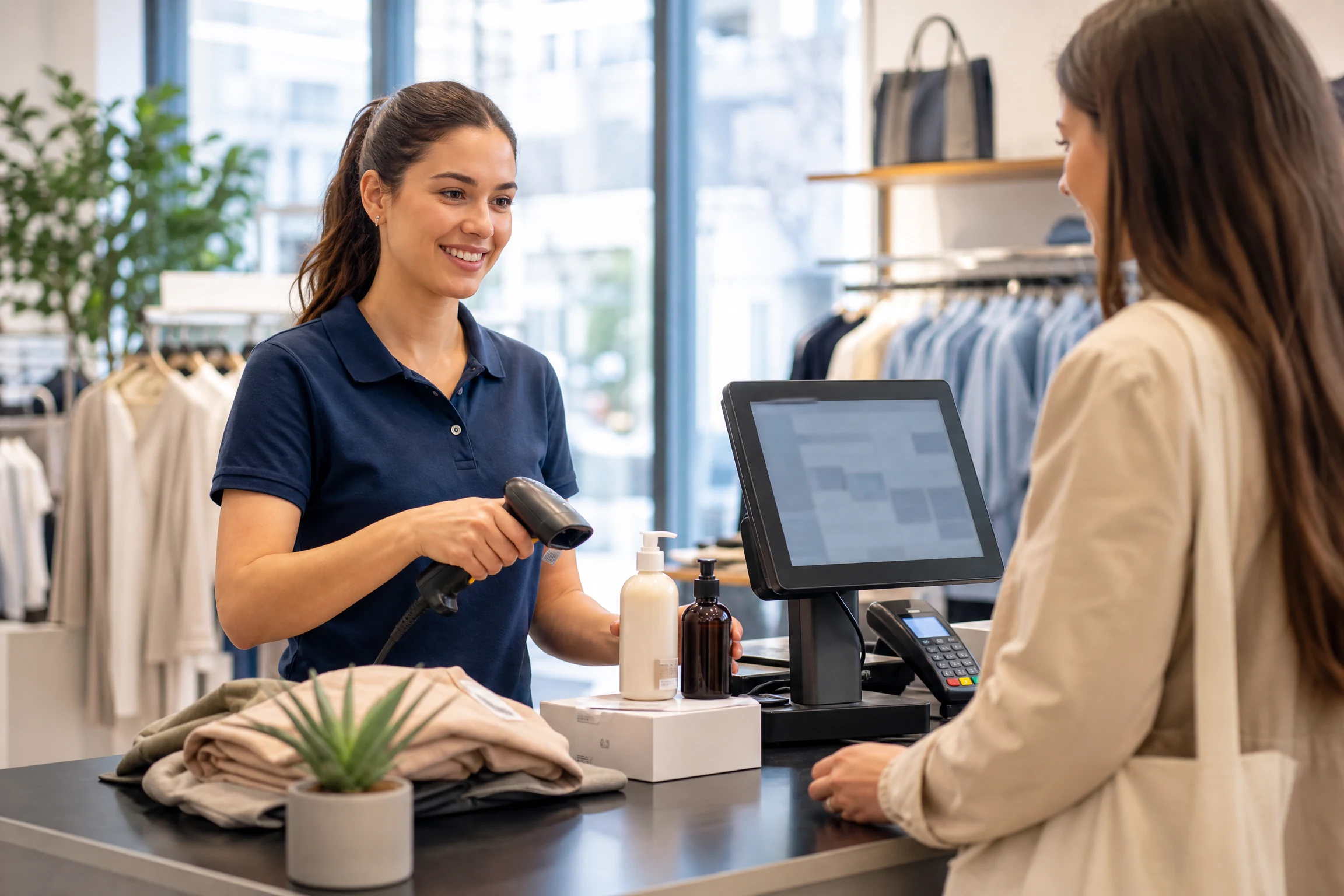
A cashier is the person who turns a basket into a paid order: scan or key the items, take cash or card, print or email a receipt, and keep the line moving without guessing the total.
People search for English for cashiers, cashier phrases, retail till English, and how to talk about money at work. This page is that counter language. It is not a store-manager course, and it is not the Customer Support overview (tickets and chat). It is also not the grocery-stocker card, which is aisle work.
US official data is the Cashiers series (SOC 41-2011). Canada uses Cashiers (NOC 65100). The UK National Careers Service does not publish a cashier-only profile; checkout work often sits inside Sales assistant. That UK page is listed as a related source, not as a cashier wage series.
What happens at the till
The loop is greet, scan, total, pay, bag, next. The English skill is the interruption inside that loop — a price check, a split tender, or a customer who changes their mind on item three.
You listen for quantity (“two of these”), for a hold (“I’m still looking”), and for a problem (“this isn’t what I grabbed”). You repeat money amounts. You do not invent a discount because the line is long.
Some stores also want a loyalty prompt or a bag question. Those scripts are house-specific. Learn the one your trainer gives you. This page does not treat any chain’s refund or ID procedure as a universal rule.
What a till job usually requires
Accuracy with money and a calm line matter more than sales speeches.
Greet and start the transaction
A short hello is enough. Then look at the items, not at a speech.
Scan or key correctly
If a barcode fails, you still need the right SKU or produce code. Ask for a price check instead of inventing a number.
State the total
Read the amount. “That’s twenty-four ten” prevents the “I thought it was twenty” argument at the pin pad.
Handle the tender
Cash, card, split pay, store credit — only the methods your till allows. Count change back if that is the house method.
Offer the receipt
Print, email, or decline. Confirm the destination if they want it emailed. Do not guess an address.
Call for help when you should
A void, an override, or a customer who is stuck is a supervisor moment. Practise the sentence that gets a lead to your lane.
Typical tasks during a cashier shift
These are the spoken beats between “next please” and “have a good one.”
Open or close a till
Count the float with a witness if that is policy. Say the amount you counted. Do not estimate the drawer.
Scan a mixed basket
Watch for doubles, produce without stickers, and items left in the bag. Ask “Was there anything in the bag?” if you cannot see.
Price check
“I’ll get a price on this” plus the item name. Hold the line with one sentence: “One moment — checking the price.”
Loyalty or membership
Ask once, the way the store trained you. If they say no, move on. Do not argue about points.
Bags
Ask whether they want a bag if the store charges or if they brought their own. Wait for the answer.
A payment that fails
“The card was declined. Do you want to try another way?” Keep the reason factual. Do not diagnose their bank.
A complaint at the till
Listen, repeat the problem, and offer the store’s actual option: price check, return desk, or a supervisor. Do not invent a refund.
Lane close
“This lane is closing — I can take you.” Then finish the customers already in your line.
Where cashiers work
Cashiers work in grocery, general merchandise, pharmacies, some food counters, theatres, and other places that take payment. BLS notes short on-the-job training and no formal credential as the typical US entry path.
The environment is standing, repetitive, and public. Peak hours stack people. Your English has to stay polite when the next customer is already placing items on the belt. Self-checkout does not remove every cashier — BLS still projects hundreds of thousands of openings a year from replacement even while it projects a decline in total employment.
This is on-site counter work. It is not remote customer support. If a posting says cashier, expect a till, a uniform rule, and a drawer you have to balance. Some shops rotate cashiers onto bagging or a self-checkout assist station during a rush. The English still starts at the money: the total, the tender, and whether the customer is finished.
Till tools and the words around them
The brand of POS changes. The need to read a total does not.
Scanner and handheld
Beep versus no beep. Produce codes. “This won’t scan” is your cue to key or to call, not to skip.
PIN pad and card reader
Tap, insert, swipe. Tell the customer which one this terminal wants. “Please tap” is clearer than pointing in silence.
Cash drawer
Notes and coin. If you are unsure of the change, count it on the counter. Speed is not worth a short drawer.
Receipt printer
Paper jam English: “I’ll reprint that.” Confirm whether they wanted the long receipt or the email.
Price gun and shelf tags
When a customer says the shelf was lower, you compare tag and till. You do not override without a lead if policy forbids it.
Radio or light for a supervisor
One sentence: lane number and the problem — “Lane 3, void” or “Lane 3, card issue.”
Cashier English: money, speed, and politeness
You need numbers you can say clearly and a way to slow the transaction for one second without sounding rude.
Greetings that fit a line
“Hi — did you find everything?” is enough. Save long small talk for an empty store.
Clarifying a quantity
“Was that two or three?” Point at the item. Guessing a quantity is how arguments start at the pin pad.
Money amounts
Practise dollars and cents, pounds and pence, or the currency on the till. Read the display. Do not rely on memory.
Payment choice
“Cash or card?” Then wait. If they split, confirm each amount: “Ten cash, the rest on the card.”
Polite holds
“One moment while I check that price.” The line can hear you. A silent freeze feels like a problem.
Closing the sale
Receipt, bags, “you’re all set.” Then look at the next person so the line knows you saw them.
Fast conversations at the counter
These are the moments that decide whether the drawer balances and the customer leaves calm.
A coupon or code that fails
Read the error in plain words: “This code isn’t applying. I can call a supervisor.” Do not promise a discount you cannot ring.
Someone wants a return at your till
If returns are a different desk, say so and point. If your till can do it, follow the store’s steps. This page does not publish a universal refund script.
A price disagreement
Compare the shelf tag and the till. Offer a check. Do not argue about what the customer “always pays.”
A long line and a complicated basket
Stay on the current customer. A nod to the line is enough. Do not rush a money count to please people behind.
A coworker needs change
If policy allows, confirm the amount out loud. If it does not, send them to the office. Drawers are not informal banks.
Shift change on a live lane
Tell the incoming cashier the last completed transaction and whether a customer is mid-pay. Then sign off the drawer the house way.
Where cashier English is hard
The difficulty is speed plus numbers, not vocabulary essays.
Sound-alike amounts
Fifteen and fifty. Thirteen and thirty. Slow down on the total. Point at the screen.
Accent and the pin pad
Customers mumble. Repeat the method: “You’d like to pay by card?” A wrong assumption wastes a tap.
Produce and unlabelled items
You may need to ask “What is this called?” without sounding like you are accusing them of something.
House scripts
Loyalty questions and bag charges are local. Learn the store’s sentence. Do not import another chain’s script.
Upset customers
Keep your voice flat and specific. Name the next step. You do not need perfect grammar. You need a clear offer.
Age or ID procedures
If a store has an ID rule, follow the trainer. This page does not teach legal age checks as universal English.
Cashier interview English
Managers listen for honesty with money, calm under a line, and whether you will call a supervisor instead of guessing.
A time you handled a money mistake
One short story: a wrong tender, a missed scan, or a customer who underpaid — and how you fixed it.
Working a rush
Say you greet, you do not skip steps, and you call for help on voids. Speed without a balanced drawer is not the goal.
Availability
Evenings, weekends, and holidays are common in retail. Answer with hours you can actually work.
Customer tone
You can say you stay polite and get a lead when a request is outside your till. That is the professional answer.
English and numbers
It is fine to say you repeat totals to confirm. Customers prefer a slow correct amount to a fast wrong one.
Market context
Cashier job-market snapshot
US figures are the BLS Cashiers series. Canada’s figures are Cashiers (NOC 65100). The UK has no cashier-only National Careers Service wage profile on the date we checked; checkout work often appears under Sales assistant, which is broader than a till-only job.
- $31,190Median annual wage for cashiers
- $14.99 / hourMedian hourly wage for cashiers
- 3,157,200Employment of cashiers
- Decline (−10%)Projected employment change for cashiers
BLS links much of the projected decline to self-checkout and related retail changes. This is not a forecast for every store or every city.
- 542,600Projected average annual openings for cashiers
Most openings come from replacement — people leaving the occupation — not from net job growth.
- C$16.00 / hourMedian national wage for cashiers (NOC 65100)
Includes stores, restaurants, theatres, recreation, and some office payment points — not grocery-only.
- 744 advertised jobsJob Bank advertised openings snapshot for NOC 65100
Job-posting counts change quickly. This is a snapshot, not a permanent employment total.
Free Stage 1
Start Cashier English Stage 1
Stage 1 is free on this website: listening, vocabulary, grammar, sprint, and quiz for checkout, scanning, payments, receipts, and customer questions. Later stages stay in the Speak2Work iPhone app and are not published here.
Listening
Hear interviewer and candidate turns from a cashier phone screening.
Vocabulary
Learn words for checkout, scanning, payments, receipts, and customer questions.
Grammar
Fill the gaps in short sentences about tills, payments, and helping customers.
Sprint
Build answers from listening phrases for cashier interview English.
Quiz
Answer multiple-choice questions about Cashier Stage 1 English.
Related English on Speak2Work
English for Customer Support
Longer problem-solving English — different from a till, useful if you later move to a service desk.
English for Servers and Waiters
Another customer-facing path with money talk, in a dining room instead of a lane.
English for Grocery Store Stockers
Aisle, dates, and back-room language — the floor, not the till.
Cashier interview English
Practice answers about rushes, drawers, and calling a supervisor.
Workplace English
Polite phrases you reuse with coworkers and the public.
English Guides
Short guides for work talk and interviews.
Questions about cashier English
What English does a cashier need?
You need greetings, numbers, payment words, and a polite way to ask someone to repeat a quantity. You also need one sentence that gets a supervisor to your lane.
Is cashier English the same as customer-support English?
No. Support English is usually tickets, accounts, and longer explanations. Cashier English is a live counter: scan, total, tender, next. Speak2Work keeps those as separate paths.
Are cashier jobs disappearing?
BLS projects a 10% decline in US cashier employment from 2024 to 2034 and still projects about 542,600 openings a year from people leaving the job. Self-checkout is part of that story. A given store may still be hiring.
Do I have to handle returns and refunds?
Only if that store’s till is set up for it. Many shops send returns to a desk. Ask in training. This page does not treat refunds as a universal cashier duty.
How can I prepare for a cashier interview in English?
Practise saying a total, asking cash or card, and telling one story about a mistake you corrected. State the hours you can work, including weekends if you can.
Are there free cashier English lessons on this website?
Yes. Stage 1 Listening, Vocabulary, Grammar, Sprint, and Quiz are free on this website. Reading and later stages stay in the Speak2Work iPhone app.
Trust
Sources and data notes
Cashier, checkout operator, and sales assistant overlap in everyday talk. Official series names are kept below so a grocery till is not treated as every retail job.
Occupational Outlook Handbook: Cashiers
U.S. Bureau of Labor Statistics. Reference period: 2024–2034. Last verified: 2026-09-09.
Cashier, customer service wages
Government of Canada Job Bank / Labour Force Survey. Reference period: 2023–2024. Last verified: 2026-09-09.
Cashier, customer service market summary
Government of Canada Job Bank. Reference period: Retrieved 2026-09-09. Last verified: 2026-09-09.
Sales assistant (related UK profile — not a cashier-only wage series)
National Careers Service.
Practice cashier English
Use this overview for till language, then continue money and customer phrases in the Speak2Work app.