
Job-specific English
English for Warehouse Workers
Warehouse English is short and exact: a location, a quantity, and a yes or no. You hear it over fans, pallet jacks, and a radio that does not wait.
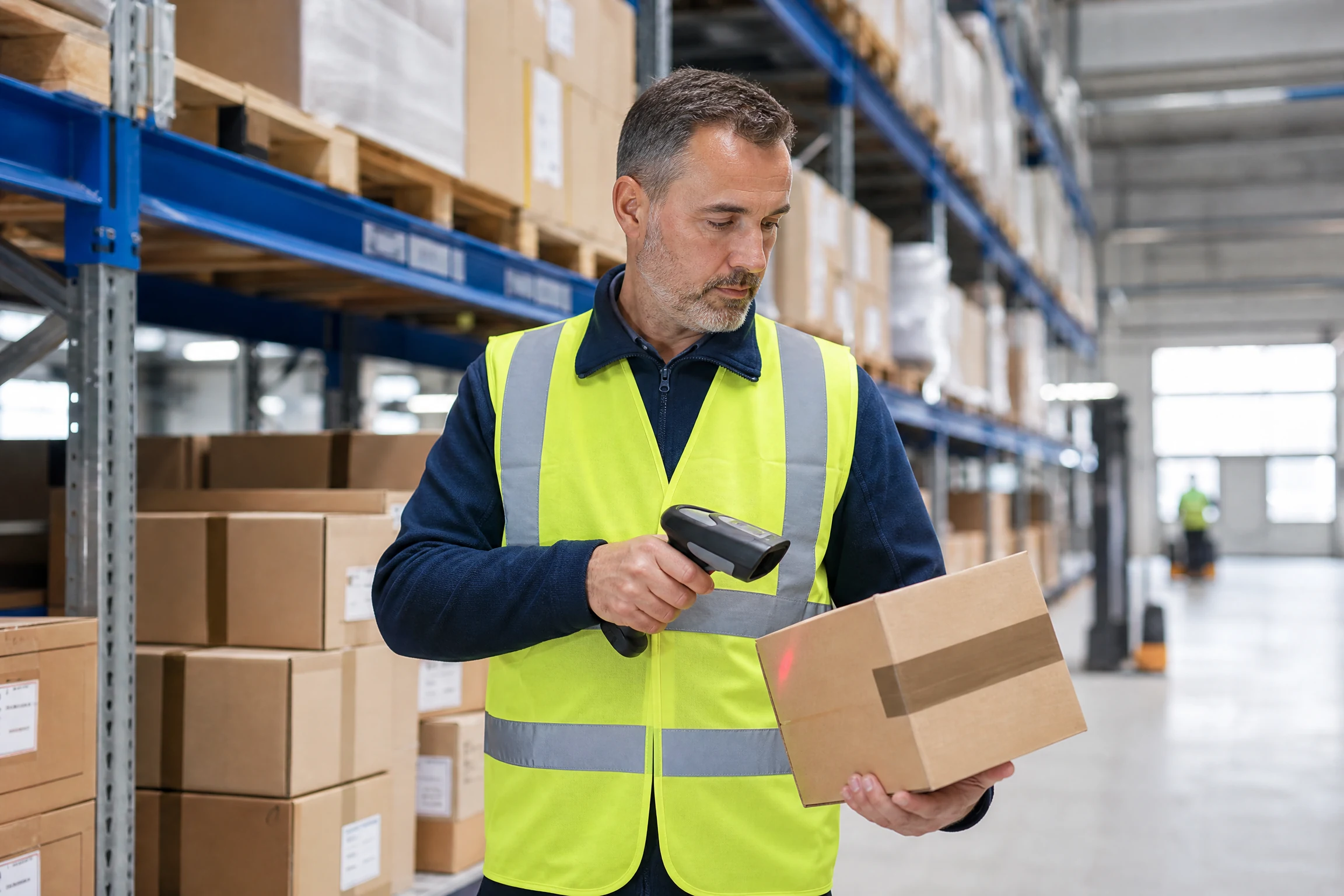
The job
What is a warehouse worker?
A warehouse worker moves goods through a building so the right carton is in the right place at the right time. The day is receiving, put-away, picking, packing, or loading — sometimes all of those on one shift.
People search for warehouse English, English for warehouse workers, picker and packer vocabulary, and dock-worker phrases. This page is that floor language. It is not a logistics-manager course and it is not a forklift licence class.
US statistics sit under Hand Laborers and Material Movers. A closer series is Laborers and freight, stock, and material movers, hand. Canada uses Material handlers (NOC 75101). The UK National Careers Service profile is Warehouse worker. Those titles overlap. They are not one identical job, and the numbers below say so.
What does a warehouse worker do?
You follow a ticket or a scanner. Get six of SKU 4412 from aisle H, bay 14. If the location is empty, you do not invent a substitute. You call it in.
Inbound work is counting what arrived against what the paperwork promised. Outbound work is building a pallet or a tote that a driver can take without restacking. In both directions, damaged or missing pieces have to be named out loud — “two crushed, one short” — not hidden in the wrap.
BLS describes hand laborers moving freight to and from storage, docks, trucks, and containers, and keeping track of package numbers, sometimes with a handheld scanner. That is the core of this Speak2Work path. Powered equipment exists in many sites. Certification is site-specific. Do not treat a forklift card as a universal hire requirement.
What the floor expects
Supervisors care about accuracy first, then speed. English is how you keep both from colliding.
Match the label
The SKU, lot, and quantity on the ticket have to match the carton in your hands. If they do not, stop and say so.
Use the location code
Aisle, bay, level, bin. Repeat the code before you walk. A wrong slot creates a hunt for the next shift.
Count out loud when it matters
“Twelve… that’s a full case” is better than a silent guess. Numbers are the job.
Flag damage early
Wet, crushed, open, or leaking cartons need a short report now, not at the truck.
Keep the aisle walkable
A pallet in the travel lane is a safety problem. You say “blocked” and move it or call someone who can.
Hand the shift over
Leave the next crew three facts: what is done, what is short, and which dock is live.
Typical tasks on a shift
These are the spoken moments that fill inbound and outbound work.
Receive a delivery
Check the bill of lading or ASN against the pallets. Call out shortages before the driver leaves the dock.
Scan and put away
Scan the label, confirm the slot on the gun, and place the carton so the barcode still faces the aisle.
Pick an order
Walk the wave. Confirm each line. If a location is empty, mark it short instead of substituting.
Pack and label
Right carton, right dunnage, right shipping label. Read the last four of the tracking number if the lead asks.
Build or break a pallet
Square the stack, wrap it, and say if it is overweight or leaning before it reaches the jack.
Load or unload
Stage by stop or by route if that is the house rule. Confirm the trailer number before you start.
Cycle count
Count what is on the shelf, not what the system hopes is there. Report the variance in units, not a story.
Safety call-out
Spill, horn, pinch point, dock plate. Short words. Point if the radio is noisy.
How a warehouse shift usually runs
Work happens in stockrooms, warehouses, plants, and wholesale sites. BLS notes that most hand laborers work full time, that part-time work is common, and that schedules can include nights and weekends.
A typical flow is inbound in the morning, picking through the day, and outbound at the cut-off. Peak seasons add overtime and extra temps. The UK National Careers Service notes that some warehouse jobs are temporary or seasonal. Ask the employer. Do not assume a year-round roster.
The building is loud and physical. BLS flags high injury rates for hand freight movers: lifting, bending, and repetitive strain. English here is often a warning — “watch the jack,” “plate is up,” “that pallet is leaning” — not a long explanation. This is on-site work. Warehouse English is not a remote-job path.
Equipment and floor language
You do not need every machine. You do need the names your site actually uses.
Handheld scanner
Beep, error, “won’t scan.” You still have to read the printed SKU if the label is torn.
Pallet jack
Manual or electric. “Jack coming through” is a courtesy that prevents collisions in a blind aisle.
Pallets and wrap
Chep, whitewood, broken board. Say if a pallet is unsafe to stack before someone builds on it.
Labels and paperwork
BOL, packing slip, shipping label, license plate. The English is the field names, not the software brand.
Powered equipment
Reach truck, sit-down forklift, order picker. Only operate what you are signed off on. Many roles never need it.
Radio or headset
Short status: location, problem, what you need. Do not narrate the whole aisle.
Warehouse English you actually hear
Floor English is compressed. A missed number becomes a mis-pick. A missed warning becomes an injury.
Locations
“H-14-B, second level.” Repeat the code. If two bays sound alike, spell the letter.
Quantities
Cases versus eaches. “Six cases, not six units.” Confirm the unit of measure when the ticket is ambiguous.
Confirmations
“Copy.” “Got it — twelve.” “Say again, dock number?” Silence is how wrong pallets leave the building.
Damage and shorts
Name the defect and the count: “Three leaking. Two missing from the ASN.” Then wait for the next instruction.
Safety phrases
Behind you. Horn. Spill in aisle C. Plate down. These are not optional politeness — they are how people keep limbs.
Handover notes
Write what the next shift can act on: “Trailer 441 still on door 3. Wave 7 short on 4412.”
Spoken moments on the floor
These are the conversations that decide whether the truck leaves on time.
A lead changes the wave
Stop picking. Repeat the new aisle or the new cut-off time. Ask which cartons already in your tote still count.
The scanner will not beep
Read the SKU aloud. Ask whether to key it in or to quarantine the carton. Do not skip the line.
A pallet is short
Tell the receiver or the lead the expected count and the actual count. Offer to recount. Do not pad the number.
Someone needs a dock
“Door 6 is free” or “Door 6 has a live unload.” Location first. Story later.
A coworker cannot hear you
Get closer, point, or use the radio. Shouting a number across a fan is how 15 becomes 50.
End of shift
Say what is staged, what is blocked, and which trailer is mid-load. Then clock out. Do not leave a mystery stack.
Where warehouse English is hard
The difficulty is not essays. It is numbers, codes, and noise.
Sound-alike codes
B and D, 15 and 50, aisle H and aisle 8. Slow down and confirm. Native speakers get these wrong too.
Unit-of-measure traps
Case, inner pack, each, pallet. If the ticket is unclear, ask “Is that cases or pieces?” before you pick.
Fast radio English
Leads drop words. “Need two on 7” might mean two pallets on door 7. Ask once rather than guessing the noun.
Reporting bad news
You need a calm sentence for “I dropped a case” or “I picked the wrong SKU.” Hiding it costs more time later.
Safety vocabulary under stress
Learn the site’s stop words before you need them. You will not invent “pinch point” in the moment.
Written variances
Cycle-count notes are short and numeric. Avoid long excuses. The system wants a count and a reason code.
Warehouse interview English
Hiring managers listen for reliability, counting, and whether you will speak up about a short or a hazard.
A time you caught an error
Tell one short story: wrong label, short pallet, or damaged wrap — and what you said to the lead.
Physical work
Say you can stand, lift within the site’s limit, and work a full shift. Ask what the weight limit actually is.
Equipment
Name what you have used: scanner, jack, wrap. If you have forklift experience, say so. If you do not, say you are willing to train. Do not claim a licence you do not have.
Shift availability
Nights and weekends are common. Answer with hours you can actually work.
English on a noisy floor
You can say you repeat location codes and quantities. That is a safety habit, not a weakness.
Market context
Warehouse job-market snapshot
US numbers come from BLS hand-laborer data, with a closer series for hand freight and material movers. Canada’s figure is Material handlers (NOC 75101). The UK page is a National Careers Service role profile without a published salary range on the date we checked it. Wages and hours vary by site, shift, and season.
- $37,680Median annual wage for hand laborers and material movers
This is the BLS group. It includes warehouse-style hand labor plus stockers, packers, vehicle cleaners, refuse collectors, and machine feeders.
- $38,940Median annual wage for laborers and freight, stock, and material movers, hand
Narrower SOC 53-7062 series inside the group — closer to dock, freight, and warehouse floor work.
- $42,880Median annual wage for the group in transportation and warehousing
Industry slice of the wider hand-laborer group, not a warehouse-only series.
- 2,988,900Employment of laborers and freight, stock, and material movers, hand
- 1% growthProjected employment change for laborers and freight, stock, and material movers, hand
The wider hand-laborer group is projected at 4%. BLS notes some warehouses add conveyors and sorting systems.
- 1,008,300Projected average annual openings for hand laborers and material movers
Openings are for the whole group, not SOC 53-7062 alone.
- C$22.00 / hourMedian national wage for material handlers (NOC 75101)
Covers transportation, storage, manufacturing, and retail or wholesale warehouses — not one fulfillment brand.
- 556 advertised jobsJob Bank advertised openings snapshot for NOC 75101
Job-posting counts change quickly. This is a snapshot, not a permanent employment total.
Free Stage 1
Start Warehouse Worker English Stage 1
Stage 1 is free on this website: listening, vocabulary, grammar, sprint, and quiz for warehouse picking, scanning, inventory, and safety English. Later stages stay in the Speak2Work iPhone app and are not published here.
Listening
Hear interviewer and candidate turns from a warehouse phone screening.
Vocabulary
Learn words for picking, scanning, pallets, inventory, and dock work.
Grammar
Fill the gaps in short sentences about shifts, counts, safety, and equipment.
Sprint
Build answers from listening phrases for warehouse interview English.
Quiz
Answer multiple-choice questions about Warehouse Worker Stage 1 English.
Related English on Speak2Work
English for Security Guards
Access language, radio updates, and short written reports — useful if your site shares a gatehouse.
English for Delivery Drivers
Addresses, access, and door reports — after the carton leaves the dock.
English for Grocery Store Stockers
Supermarket shelves and expiry dates, not warehouse waves.
English for Construction Helpers
Site labour and materials — not an indoor dock wave.
Warehouse interview English
Practice answers about counting, shifts, and telling a lead about a short.
Practise shift changes and availability
Use clear English for warehouse schedules, coverage, and changed start times.
English Guides
Short guides for work talk and interviews.
Questions about warehouse English
What English does a warehouse worker need?
You need location codes, quantities, confirmations, and a few safety phrases. You also need to report damage or a short in one sentence. Long presentations are rare on the floor.
Do I need forklift English or a forklift licence?
Not for every warehouse job. Many roles are scanner, jack, and hand stacking. The UK National Careers Service notes that some employers provide forklift training after probation. Ask the site. Do not treat certification as universal.
Is a warehouse worker the same as a material handler?
The work overlaps. Material handler is the Canadian NOC title and a common US job-ad title. Speak2Work’s warehouse path covers receiving, picking, packing, and dock talk. Official statistics still use their own group names.
Are warehouse jobs declining because of automation?
BLS still projects growth for hand freight movers, while noting that some warehouses add conveyors and sorting systems. Stockers and order fillers have a stronger projected increase than some other group members. A posting is not a national forecast.
How can I prepare for a warehouse interview in English?
Practice repeating a location code, a quantity, and one story about catching a mismatch. Say which shifts you can work. Name the equipment you have actually used.
Are there free warehouse English lessons on this website?
Yes. Stage 1 Listening, Vocabulary, Grammar, Sprint, and Quiz are free on this website. Reading and later stages stay in the Speak2Work iPhone app.
Trust
Sources and data notes
Warehouse worker, material handler, picker, and freight laborer are related titles. Each figure below keeps its official occupation name, geography, and period.
Occupational Outlook Handbook: Hand Laborers and Material Movers
U.S. Bureau of Labor Statistics. Reference period: 2024–2034. Last verified: 2026-09-09.
Material handler wages
Government of Canada Job Bank / Labour Force Survey. Reference period: 2023–2024. Last verified: 2026-09-09.
Material handler market summary
Government of Canada Job Bank. Reference period: Retrieved 2026-09-09. Last verified: 2026-09-09.
Warehouse worker
National Careers Service.
Practice warehouse floor English
Use this page to learn the job language, then continue scanner, dock, and safety phrases in the Speak2Work app.