
Job-specific English
English for Cleaners
Cleaning English is a list you can hear: which room, which surface, which product, and whether the space is free. The useful sentences are short enough to say while you work.
The job
What does a workplace cleaner do?
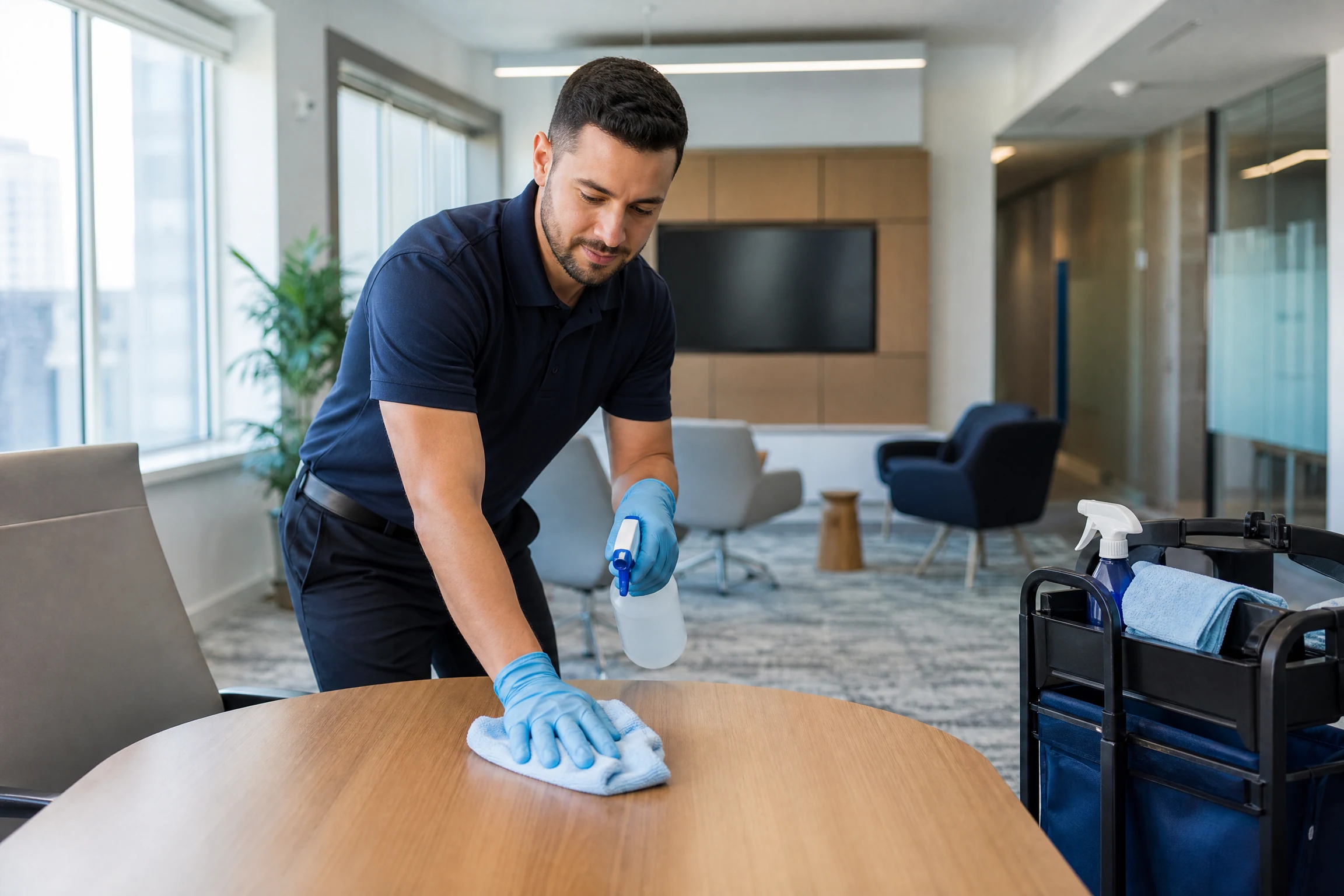
A cleaner keeps a building usable. In offices, schools, shops, and contracted sites that usually means floors, restrooms, trash, restocking, and a walk-through against a checklist — not one identical job in every building.
People search for English for cleaners, janitor English, cleaning vocabulary, and how to talk to a supervisor about a locked room. This page is commercial and workplace cleaning language. It is not a hotel-housekeeping manual and it is not industrial tank or rope-access work.
US official numbers come from Janitors and Building Cleaners. Canada’s closer series for room-by-room indoor work is Light duty cleaners (NOC 65310). A heavier Canadian series — janitors, caretakers and heavy-duty cleaners — sits beside it. The UK National Careers Service has a Cleaner profile that also mentions homes, hospitals, and some window work. Those are related occupations. This page does not pretend they are one title.
What the work looks like
You arrive with a cart and a sequence. Lobby first, or restrooms first, or the boardroom before the 9 a.m. meeting. The English problem is the exception: “Skip 4B — they are still in there.”
Most shifts are a route plus a priority list. A supervisor or a client app may change the order: a spill on 3, a checkout on 2, a restroom out of paper. You confirm the new first stop before you keep walking the old route.
When something is broken — a leak, a cracked tile, a door that will not lock — the job is to report it in a way someone can act on. “Men’s restroom, second floor, sink dripping” is a complete message. “It’s bad in there” is not.
What sites usually expect
Reliability and a finished checklist matter more than fancy English. You still have to understand the instruction that changes the checklist.
Follow the area list
Offices, corridors, restrooms, kitchenette, stairs. Do the rooms in the order you were given unless someone moves a priority.
Use the named product
Glass, disinfectant, floor cleaner. Mixing “whatever is on the cart” is how finishes get ruined and how people get hurt.
Leave a room usable
Trash out, surfaces dry enough to use, supplies refilled, signs removed when the floor is safe.
Respect a closed door
Ask if a room is free. Do not walk in on a meeting because the schedule said empty.
Report damage and hazards
Water, broken glass, blood, a smell you cannot explain. Name the room and what you saw.
Sign the checklist honestly
If you skipped a room, say so. A ticked box for work you did not do becomes someone else’s problem at 8 a.m.
Typical tasks on a cleaning shift
These are the moments that need a word, not just a mop.
Start-of-shift briefing
Hear which floors are live, which rooms to skip, and whether a product is out. Repeat the first priority.
Restrooms
Clean fixtures, refill soap and paper, empty bins. Put a sign up if the floor is wet. Take the sign down when it is not.
Offices and meeting rooms
Wipe tables, empty trash, straighten chairs. Do not throw papers that look like documents. Ask if a pile is trash.
Floors
Sweep, mop, or machine as trained. Warn people before a wet stretch: “Slippery — use the other hall.”
Kitchenette or break room
Counters, sink, appliance exteriors if that is on your list. Food waste goes where the site said, not in the nearest bin.
Supplies
Restock the cart. Say when you are low on gloves or liners before the closet is empty.
A blocked room
Knock, wait, ask “Is it okay to clean now?” If they say later, write the room on your leftover list.
End of route
Return keys or fobs, empty the cart, and tell the lead what you could not finish.
Where cleaners work, and when
Workplace cleaners are in offices, schools, shops, clinics’ public areas, and buildings run by a contractor. Many shifts are early, late, or overnight so the space is empty. Some sites clean during the day around staff.
BLS treats janitors and building cleaners as a large on-site occupation with short training. The UK cleaner profile also lists homes, hospitals, and vehicles. Speak2Work’s cleaner path stays on contracted indoor workplaces. Hotel room cleaning is a different Speak2Work card (Hotel Housekeeper) and does not have a live overview page yet.
You may work alone on a floor or with a pair. English then is either a radio to a supervisor or a sentence to a tenant: “I can come back after your call.” This is physical, on-site work. It is not a remote job.
Supplies, signs, and checklists
The cart is a vocabulary list. Learn the names your site printed on the bottles.
Chemicals and dilution
The UK cleaner profile mentions mixing detergents in the right amounts. Use the posted ratio. Do not invent a stronger mix.
Cloths and colour codes
Many sites keep restroom cloths separate from kitchen cloths. Ask which colour is which on day one.
Vacuum, mop, auto-scrubber
Say if a machine is jammed or the pad is worn. “It’s broken” is weaker than “the squeegee is torn.”
Wet-floor signs
Put them where people walk, not where they look decorative. Remove them when the floor is safe.
Keys, fobs, and alarms
If you open a locked suite, you are responsible for leaving it locked. Confirm that in one sentence at handover.
The checklist or app
Photos and ticks are part of some contracts. If the app wants a photo of the restroom, take that photo — not a hallway.
Cleaning English that keeps a shift moving
You need instruction English, product English, and a polite way to interrupt a room that is still occupied.
Rooms and surfaces
Lobby, stall, basin, cubicle, skirting, glass, stainless. Point if you do not know the noun yet — then learn the noun.
Priority language
“Do the boardroom first.” “Leave the lab.” Repeat the exception so you do not mop the one room they needed dry.
Asking if a space is free
Knock. “Cleaning — is now a good time?” Wait. A locked door is information, not a dare.
Warning language
Wet floor. Closed for cleaning. Do not use this sink. Signs only work if you also say the warning to the person walking in.
Reporting a problem
Where, what, when you saw it. “Third-floor kitchen, water under the fridge, 7:10.” That is enough.
Finishing a job
“Boardroom is done. 4B was occupied — I’ll return.” Completion English is a status, not a speech.
Talking to supervisors, tenants, and teammates
Most conversations last ten seconds. They still have to be accurate.
A tenant is still at the desk
Offer a time: “I can do the bins now and the floor after 6.” Do not hover with a vacuum while they are on a call.
The product is wrong for the surface
Say “This bottle is for glass — the wood needs the other one.” Then go get the other one.
You find something that is not trash
A badge, a wallet, a printed contract. Take it to the lead or the front desk. Do not decide it is junk.
A spill that is not water
Stop. Ask whether the site has a special kit. Do not mop an unknown liquid because you want to stay on schedule.
A teammate finished your area
Confirm what is left: “Did you already do the stairs?” Duplicate work is how restrooms get skipped.
Handover to the day crew
Name the rooms you could not enter and any wet floors still drying.
Where cleaner English is hard
The hard part is product names, room numbers, and interrupting politely.
Look-alike bottles
Labels are fast English. If you cannot read the hazard word, ask before you spray. “What is this for?” is a professional question.
Room numbers in a hurry
4B and 4D. Fifteen and fifty. Repeat the number. Write it on your leftover list.
Interrupting a meeting
You need a polite opener that still gets a yes or no. Practise one sentence. Do not start cleaning around people’s laptops without asking.
Hazard words
Wet, sharp, biohazard, out of order. Learn the site’s stop words. You will not have time to translate in a restroom.
Checklist English
Apps want short status. “Occupied — return” is better than a paragraph about why the lawyer was still there.
Night-shift isolation
If you work alone, your English may be a text or a voicemail to a supervisor. Practise leaving a complete location.
Cleaner interview English
Supervisors listen for reliability, honesty about a missed room, and whether you will ask before you use a new chemical.
A time you followed a change of plan
Tell one story: a spill, a locked room, or a VIP area that moved to the top of the list.
Chemicals and safety
Say you read labels and ask when you do not recognise a product. That is the expected answer.
Working around people
Explain how you ask if a room is free. Sites care about this more than they care about vacuum brands.
Hours
Early, late, and weekend shifts are common. Answer with times you can actually start.
Physical work
The job is walking, bending, and pushing a cart. Say so plainly. Ask about the building’s floors and stairs.
Market context
Cleaner job-market snapshot
US figures are for janitors and building cleaners — commercial and institutional buildings, not the maid and housekeeping series. Canada’s main figure here is light-duty cleaners, with a related janitor wage shown as context. The UK page is a National Careers Service cleaner profile without a published salary range on the date we checked it.
- $35,930Median annual wage for janitors and building cleaners
This is commercial and institutional building cleaning. It is not the BLS Maids and Housekeeping Cleaners series used for many hotel-room and private-home roles.
- $17.27 / hourMedian hourly wage for janitors and building cleaners
- 2,447,700Employment of janitors and building cleaners
- 2% growthProjected employment change for janitors and building cleaners
BLS calls this slower than average. It is not a forecast for every contractor or every night crew.
- 47,800Projected employment change (number of jobs)
- C$19.74 / hourMedian national wage for light duty cleaners (NOC 65310)
NOC 65310 includes offices, hotels, hospitals, schools, and private residences. It is broader than one office-cleaning contract.
- 1,236 advertised jobsJob Bank advertised openings snapshot for NOC 65310
Job-posting counts change quickly. This is a snapshot, not a permanent employment total.
- C$21.00 / hourMedian national wage for janitors, caretakers and heavy-duty cleaners (NOC 65312)
Related heavier series (floors, grounds, building care). Not the same as light-duty office cleaning.
Free Stage 1
Start Cleaner English Stage 1
Stage 1 is free on this website: listening, vocabulary, grammar, sprint, and quiz for workplace cleaning, supplies, rooms, and hazard reports. Later stages stay in the Speak2Work iPhone app and are not published here.
Listening
Hear interviewer and candidate turns from a cleaner phone screening.
Vocabulary
Learn words for supplies, rooms, spills, and workplace hazards.
Grammar
Fill the gaps in short sentences about cleaning tasks, chemicals, and instructions.
Sprint
Build answers from listening phrases for cleaner interview English.
Quiz
Answer multiple-choice questions about Cleaner Stage 1 English.
Related English on Speak2Work
English for Landscapers
Outdoor crew language — a different job, useful if your site also has grounds work.
English for Hotel Housekeepers
Guest rooms, stayovers, and linen status — not an office night contract.
Cleaner interview English
Practice answers about checklists, chemicals, and asking if a room is free.
Workplace English
Polite interruptions and status updates you reuse in any building.
English Guides
Short guides for work talk and interviews.
Questions about cleaner English
What English does a cleaner need at work?
You need room names, surface names, product names, and a way to ask if a space is free. You also need a short report for leaks, breakage, or a room you could not enter.
Is a cleaner the same as a janitor or a housekeeper?
The work overlaps. Janitor and building cleaner is the US official series used on this page. Housekeeper often means hotel rooms or homes — a different BLS series and a different Speak2Work card. Canada splits light-duty cleaners from heavier janitor and caretaker work.
Do I need chemical or infection-control English?
On a standard office contract you need label English and the site’s dilution rules. Hospital or care-home work can add infection-control procedures — the UK cleaner profile mentions that. Do not treat hospital protocol as the default for every job.
How do I ask if a room is available?
Knock, wait, and ask “Is now a good time to clean?” If they say no, write the room down and return. Do not start the vacuum over a meeting.
How can I prepare for a cleaner interview in English?
Practise naming the areas you have cleaned, one story about a change of plan, and how you report a hazard. Say which shifts you can work.
Does Speak2Work have free web lessons for cleaners?
Yes. Stage 1 Listening, Vocabulary, Grammar, Sprint, and Quiz are free on this website. Reading and later stages stay in the Speak2Work iPhone app.
Trust
Sources and data notes
Cleaner, janitor, custodian, light-duty cleaner, and housekeeper are related titles. Each figure keeps its official occupation name.
Occupational Outlook Handbook: Janitors and Building Cleaners
U.S. Bureau of Labor Statistics. Reference period: 2024–2034. Last verified: 2026-09-09.
Light duty cleaner wages
Government of Canada Job Bank / Labour Force Survey. Reference period: 2023–2024. Last verified: 2026-09-09.
Light duty cleaner market summary
Government of Canada Job Bank. Reference period: Retrieved 2026-09-09. Last verified: 2026-09-09.
Custodian / janitor market summary
Government of Canada Job Bank. Reference period: Retrieved 2026-09-09. Last verified: 2026-09-09.
Cleaner
National Careers Service.
Practice workplace cleaning English
Use this overview for rooms, supplies, and reports, then continue the spoken drills in the Speak2Work app.