
Job-specific English
English for Handymen
Handyman English is the problem the customer names, the access they give you, and one honest sentence about what you can fix today — not a promise to do licensed work you cannot do.
The job
What is a handyman?
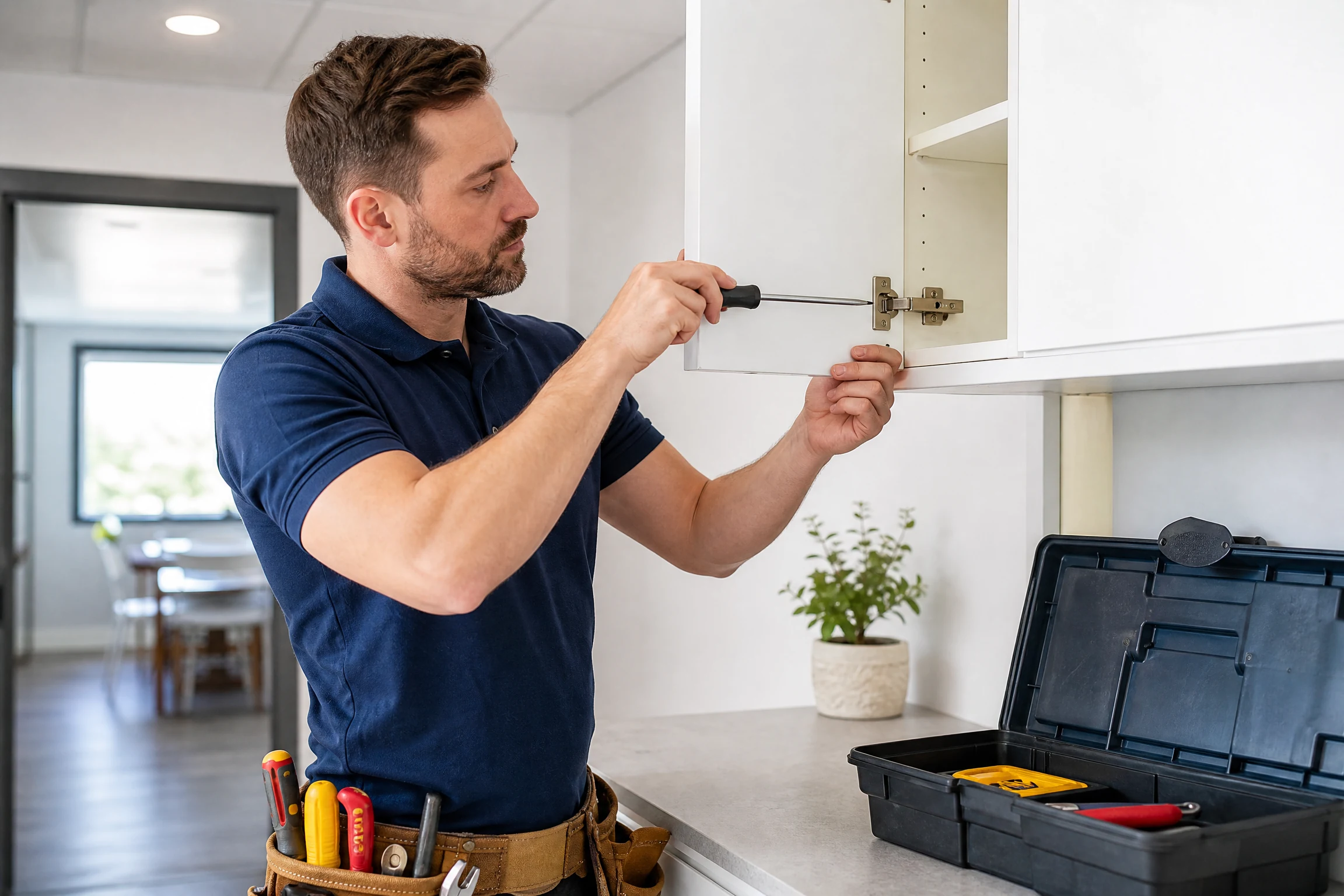
A handyman or maintenance worker handles small repairs and upkeep: doors, hardware, shelves, furniture, minor patches, and other jobs a customer or building can describe in one visit.
People search for English for handyman jobs, handyman English vocabulary, maintenance English, repair worker English, and handyman interview English. This page is customer-facing repair language in finished spaces. It is not the Construction Helper overview (a crew site). It is not Painter (a full paint spec). It is not a licensed electrician or plumber page.
There is no clean official occupation named only “Handyman.” US figures below are General maintenance and repair workers (SOC 49-9071), a broader building-and-equipment series. Canada’s closest Job Bank group used here is General building maintenance workers and building superintendents (NOC 73201). The UK National Careers Service does not publish a handyman-only profile; Caretaker is listed as a related extra source, not as the same job. Regulations on electrical, gas, plumbing, and structural work vary by jurisdiction. This page does not treat a handyman as licensed to do that work everywhere.
What happens between the knock and “I’m done”
The loop is hear the problem, look at it, say what you can do, do that work, and confirm the finish — or say you need another trade.
BLS describes general maintenance workers using skills from more than one craft to keep buildings and equipment in repair. A residential handyman visit is often narrower: a sticking door, a shelf, a dripping handle you are allowed to tighten, or a small patch. A building-maintenance job may add rounds, work orders, and calling contractors.
Some customers ask for “whatever it takes.” Your English job is to name the scope. If the work is regulated where you are, you stop and say so. This page does not give legal advice and does not teach you to bid prices.
What a handyman usually handles
A clear scope protects you more than saying yes to every request.
Hear the request
Repeat the problem in your words: which room, what failed, when it started. “The bathroom door won’t latch” is a job. “Fix everything” is not.
Confirm access and time
Keys, codes, pets, and which hours you can work. Say if you need the water off. Do not enter a space you were not shown.
Look before you promise
Say what you can see. If you need to open a wall or pull a fixture, ask first.
Name the scope
“I can rehang this door today. I cannot rewire the switch.” That sentence is the job. Rules vary — follow the local ones.
Do the small repair
Hardware, shelves, furniture, minor patching, and cleanup. Measure twice. Bring the part you named, not a close guess.
Report extra damage
Rot, a cracked tile you found, or a leak behind the cabinet. Show it. Do not hide it behind a closed door.
Typical tasks on a handyman visit
These are the spoken beats between the first look and a swept floor.
A door that sticks or will not latch
Ask whether they want it planed, the strike moved, or new hinges. Do one thing and test it with them watching.
A shelf or furniture piece
Confirm the height and the wall type. “Is this okay here?” before you drill.
A fixture or handle
If it is a simple tighten or swap you are allowed to do, say so. If it needs a licensed trade, stop.
A small patch
Name the size and whether it will need paint later. You are not automatically the painter.
A part you do not have
Describe the part, not a brand pitch. “I need a 3-inch hinge, same overlay” is enough. Ask before you leave to buy it.
An extra job they add mid-visit
Repeat the new request. Say if it fits today. Do not silently expand the scope.
Cleanup and walk-through
Show the repair, test it, and ask if anything still feels wrong. Then pick up the dust.
A work order in a building
Unit number, request, and done or not done. “Could not complete — need plumber” is a valid close.
Where handymen and maintenance workers work
The work is in homes, apartments, small businesses, and some facilities. You are usually a guest in someone else’s space.
BLS places general maintenance workers in buildings and with equipment. Canada’s NOC 73201 names offices, apartments, schools, and other establishments, including superintendents. A mobile handyman and a building caretaker share some English — access, small repairs, calling a contractor — and differ on rounds and residents. The UK Caretaker profile is closer to a building than to a freelance van.
This is not a construction crew and not a full paint contract. If a posting says maintenance technician, the employer may expect more systems work. If it says handyman, expect mixed small jobs. In every case, licensed work stays licensed. Ask what you are allowed to touch in that city.
Tools and the words around them
The brand of drill changes. The need to name the part does not.
Hand tools
Screwdrivers, hammer, pliers, knife. Ask which bit if two look the same in a dim hallway.
Drill and fasteners
Anchor type and length. “Drywall or wood?” changes the hardware.
Tape measure and level
Call the number and show the bubble. Customers remember a crooked shelf.
Patch and caulk
Name the product you will use only as a material, not a recommendation to buy a brand.
Toolbox and drop cloth
Protect floors. Say if you need the room cleared before you start.
Phone photos
A picture of a part or a hidden leak is how you report extra damage without a speech.
Handyman English you actually use
You need problem words, access words, and one honest limit sentence.
The customer’s problem
Stuck, loose, leaking, squeak, won’t close, came off the wall. Repeat their words, then your diagnosis.
Access and timing
Key, code, pet, after 3, don’t use the front. Those details are the visit.
Scope language
I can / I cannot / I need another trade. This is not a price lesson. It is a boundary.
Parts and measurements
Hinge, latch, anchor, length. Bring the size you measured, not “something like that.”
Completion
Done, tested, still needs paint, still needs a plumber. A building lead can close a ticket from those words.
A calm “I need to look first”
Do not quote a fix you have not seen. Looking is part of the English.
Conversations in someone else’s home
These are the moments that decide whether the customer trusts the repair.
They describe three problems at once
Write them. Ask which one is first. Do not start the third while the door is still off.
They want a cheaper shortcut
Say what that shortcut will fail. Offer the smaller safe job or a specialist. Do not invent a price lecture.
You find extra damage
Show it. Ask how they want to proceed. Do not cover it and leave.
The work is licensed where you are
Use a plain sentence: “I can’t do that here — you need a licensed plumber.” Then stop.
A resident or pet is in the way
Ask for a clear path. “I need this wall empty to drill safely” is polite and specific.
They add a paint request
That may be a different job. See Painter. Say if you only came to patch.
Where handyman English is hard
The difficulty is the customer’s story and your limit sentence, not tool essays.
Vague problem names
“It’s weird” is not a diagnosis. Ask “does it leak, stick, or make a noise?”
Hardware names
Latch, strike, overlay, mortise. Show the part if the word fails.
Measurements in two systems
Inches and millimetres. Write the number you will buy against.
Polite no
Practise “I can’t do electrical work in this city” before a customer pushes.
Building tickets versus home visits
A work order has a unit number. A homeowner has a story. Learn both closings.
Materials without selling
Describe the part you need. Do not turn the visit into a shopping pitch.
Handyman interview English
Managers and customers listen for whether you will look first, stay in scope, and say when you need another trade.
A repair you finished and tested
One short story: the problem, what you did, and how you showed it worked.
A job you turned down
Name the licensed or unsafe work you would not do. That is a professional answer, not a weakness.
Working in occupied homes
Say you protect floors, you ask before drilling, and you clean up. Customers hire that English.
Tools and vehicles
Name what you actually have. Do not claim a licence or a van you do not have.
English with customers
It is fine to say you repeat the problem and the plan out loud. Clarity is the point.
Market context
Handyman job-market snapshot
There is no exact official series named only “Handyman.” US figures are General maintenance and repair workers (SOC 49-9071), a broader proxy. Canada’s figures are General building maintenance workers and building superintendents (NOC 73201), also broader than a mobile odd-job visit. The UK Caretaker page is a related building role, not a handyman wage series, so no UK pay figure is shown. Licensed-trade rules vary by jurisdiction.
- $48,620Median annual wage for general maintenance and repair workers
SOC 49-9071 is a broader series: building and equipment maintenance, not a clean “handyman-only” occupation. Many ads still use the handyman title.
- 1,629,700Employment of general maintenance and repair workers
This count includes facility and building maintenance roles, not only residential odd-job visits.
- 4% growthProjected employment change for general maintenance and repair workers
BLS projects about 62,400 additional jobs in the series. It is not a forecast for every handyman listing.
- C$25.00 / hourMedian national wage for general building maintenance workers and building superintendents (NOC 73201)
NOC 73201 includes building superintendents and general building maintenance — a broader proxy than a mobile handyman visit.
- 360 advertised jobsJob Bank advertised openings snapshot for NOC 73201
Job Bank advertised jobs — snapshot retrieved 2026-09-09. This snapshot is for NOC 73201, not a handyman-only total.
Free Stage 1
Start Handyman English Stage 1
Stage 1 is free on this website: listening, vocabulary, grammar, sprint, and quiz for small repairs, access, tools, and customer requests. Later stages stay in the Speak2Work iPhone app and are not published here.
Listening
Hear interviewer and candidate turns from a handyman hiring screen.
Vocabulary
Learn words for small repairs, tools, access, and customer requests.
Grammar
Fill the gaps in short sentences about fixes, hardware, and scope.
Sprint
Build answers from listening phrases for handyman interview English.
Quiz
Answer multiple-choice questions about Handyman Stage 1 English.
Related English on Speak2Work
English for Painters
Full prep and coats — more than a touch-up after a patch.
English for Construction Helpers
A crew site and materials, not a customer living room.
English for Landscapers
Outdoor grounds work some properties also hire.
Handyman interview English
Practice answers about scope, occupied homes, and saying no to licensed work.
Workplace English
Polite updates you reuse with customers and leads.
English Guides
Short guides for work talk and interviews.
Questions about handyman English
What English does a handyman use with customers?
You need problem words, access details, and a short plan: what you will do, what you will not do, and when you will finish or return. You also need a walk-through sentence when the repair is tested.
How do I explain a repair problem?
Name the part and what failed: “The hinge screws pulled out of the drywall.” Then say the fix you can do, or that another trade is required. Show the damage if you can.
What tool vocabulary should I learn?
Learn the tools you actually carry and the hardware names customers mix up: hinge, latch, anchor, level. If the word fails, show the part.
Is handyman work the same as licensed trade work?
No. Electric, gas, structural, and plumbing work is regulated in many places. A handyman’s English includes an honest “I can’t do that here.” Rules vary. This page is not legal advice.
How is this different from a construction helper?
A helper works on a crew site with a foreman. A handyman talks to a customer in a finished space and names a small scope. Speak2Work keeps those as separate paths.
Are there free handyman lessons on this website?
Yes. Stage 1 Listening, Vocabulary, Grammar, Sprint, and Quiz are free on this website. Reading and later stages stay in the Speak2Work iPhone app.
Trust
Sources and data notes
Handyman, maintenance worker, caretaker, and superintendent overlap in ads. Official series names are kept below so a small repair visit is not treated as a licensed trade or a construction crew.
Occupational Outlook Handbook: General Maintenance and Repair Workers
U.S. Bureau of Labor Statistics. Reference period: 2024–2034. Last verified: 2026-09-09.
Apartment building maintenance worker wages
Government of Canada Job Bank / Labour Force Survey. Reference period: 2023–2024. Last verified: 2026-09-09.
Apartment building maintenance worker market summary
Government of Canada Job Bank. Reference period: Retrieved 2026-09-09. Last verified: 2026-09-09.
Caretaker (related UK building-maintenance profile — not a handyman-only wage series)
National Careers Service.
Practice handyman English
Use this overview for request and scope language, then continue customer phrases in the Speak2Work app.