Job-specific English
English for Massage Therapists
Clinic English is an intake question, a pressure check, and a professional stop if something hurts — not a medical diagnosis and not a spa sales speech.
The job
What is a massage therapist?
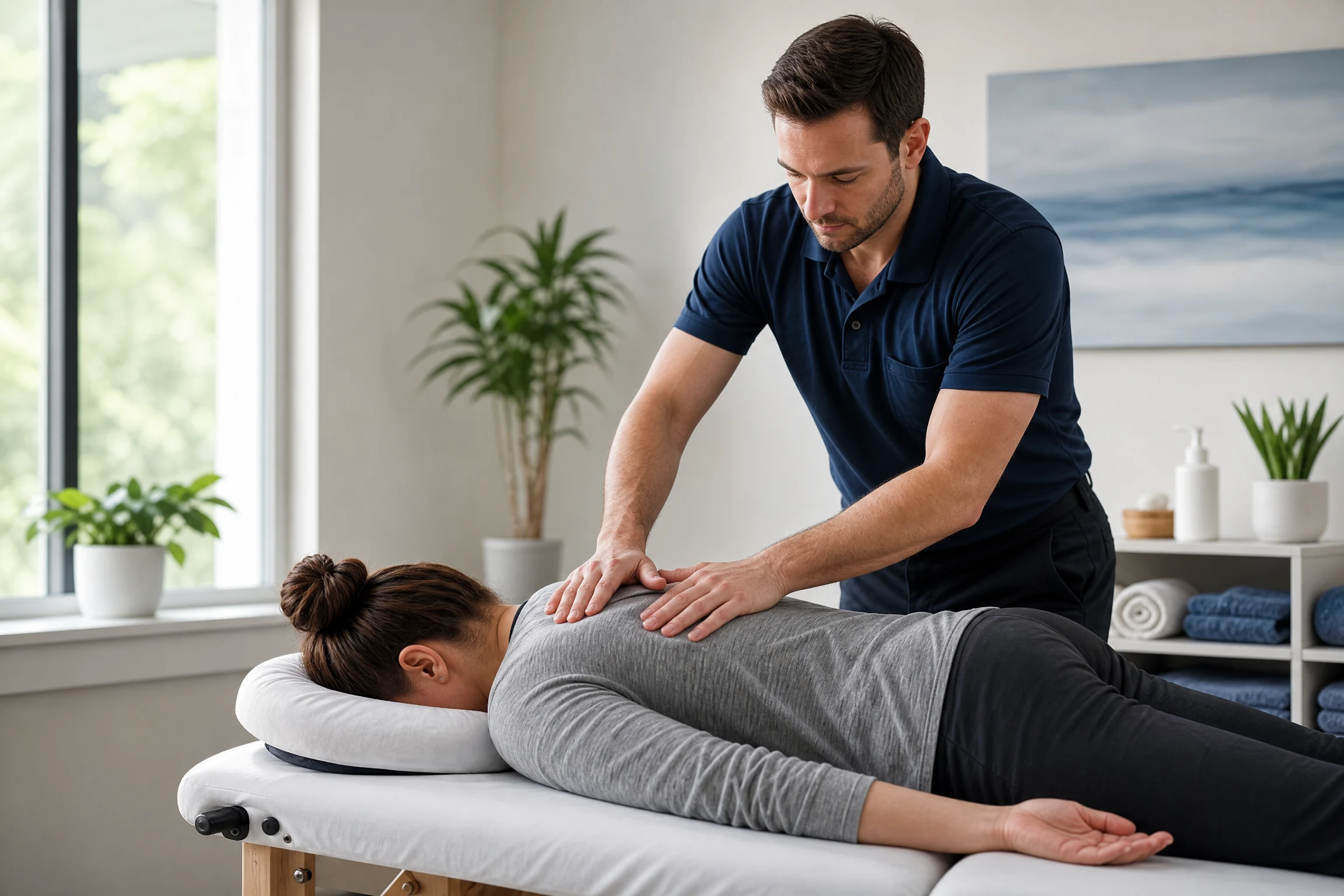
A massage therapist talks with a client about goals and comfort, applies agreed techniques to soft tissue, documents what the workplace requires, and keeps the room professional — including draping, privacy, and a clear way to stop.
People search for English for massage therapists, massage intake English, pressure preference phrases, and massage therapist interview English. This page is clinical, workplace communication. It is not a medical-school course. It does not diagnose or treat disease. It is not the Nail Technician or Hairdresser overview.
US official data is Massage Therapists (SOC 31-9011) in the BLS healthcare chapter. BLS notes that most US states regulate massage therapy and typically require a licence or certification after postsecondary training — that is a US generalisation, not a global rule. Canada’s Job Bank group used here is Massage therapists (NOC 32201), often titled registered massage therapist (RMT) on Job Bank; provincial regulation varies. The UK National Careers Service profile is Massage therapist. Ask the employer and the local regulator. This page is not licensing advice.
What happens between intake and the next booking
The loop is consent and history, a plan for this session, the massage with check-ins, a professional close, and notes if the clinic requires them.
BLS describes massage therapists talking with clients about symptoms, history, and goals, then manipulating soft tissue, documenting progress, and cleaning the workspace. In a clinic that means a form and a clock. In a spa it may mean a shorter intake. In mobile work it means a clear greeting at the door and the same professional boundaries. The English skill is consent and comfort, not a diagnosis.
If a client describes a medical problem you are not allowed to treat, you refer them to an appropriate clinician. You do not invent a treatment plan you are not qualified to give. This website does not tell you what you are legally allowed to treat.
What a professional massage job usually requires
Intake, draping, check-ins, and honest scope matter more than marketing language.
Intake without diagnosing
Ask where they want work, pressure preference, and relevant history the clinic form requires. Do not label a disease.
Consent and draping
Explain how they will be covered. Only uncover the area you are working. Professional, clinical, not casual.
Pressure check-ins
“Is this pressure okay?” Early, then as needed. A client who goes quiet is not automatically comfortable.
A clear stop
They can stop the session. You can stop a technique. Practise the sentence. No argument.
Hygiene and the room
Clean linens, clean table, sanitised tools. House protocol — learn it. Do not invent a regulation.
Notes and booking
If the clinic wants SOAP-style notes, use their template. Offer a next appointment without pressure.
Typical tasks during a clinic or spa shift
These are the spoken beats between “How is the pressure?” and “I’ll see you at reception.”
First-visit intake
Walk through the form. Confirm allergies to oils or lotions if you use them. Confirm the area of focus.
A client who wants deeper pressure
Increase only if it stays comfortable and within your training. “Tell me if this is too much.”
A client who is ticklish or tense
Slow down, explain the next area, or skip it. Do not joke in a way that breaks professional boundaries.
Time remaining
A ten-minute warning if the house uses one. Do not rush the last area so hard that they leave sore and unheard.
A request outside your scope
Name that you will not do it and, if appropriate, that they should see another professional. No medical lecture.
Late arrival
Offer a shorter session. Protect the next client. Say the remaining minutes.
Room reset
Linens, table, lights. The next person can see the room. “One moment while I reset” is enough.
Front-desk handoff
If reception books, give them the service length you actually did. Do not leave a mystery in the schedule.
Where massage therapists work
BLS lists spas, offices of other health practitioners, and a large share of self-employed therapists. Some travel to events or homes. Part-time schedules are common.
The room should feel calm and professional. Draping, lighting, and a closed door are part of the job’s English as much as the techniques. This page’s learning images and copy stay clinical. They are not sexualized.
This is not a nail table and not a hair chair. If a posting says spa therapist, read whether they want massage, esthetics, or both. If it says RMT, the employer may expect a provincial registration. Regulation varies. Do not assume a US licence equals a Canadian RMT title.
Room tools and the words around them
Table brands change. Consent language does not.
Table or chair
Height and face cradle. “Tell me if your nose feels blocked.” Small comfort words prevent a ruined session.
Linens and draping
Sheets, blankets, a way to keep covered. Explain before they undress to their comfort level.
Oil or lotion
Ask about scent and skin sensitivity. Have an unscented option if the clinic stocks one.
Bolsters
Knees, ankles, pregnancy positioning if you are trained for that population. Ask before you move a joint.
Intake form and clock
History, consent, session length. The clock is part of professionalism, not rudeness.
Sanitiser and laundry
House protocol. Ask in training. Do not copy another clinic’s rule from memory.
Massage English: intake, pressure, and professional boundaries
You need questions that get a safe session and a stop phrase that works when the client is face-down.
Intake questions
Where, how long, what they want from today. “Any areas to avoid?” is a standard workplace question, not a diagnosis.
Pressure language
Lighter, okay, too much. Agree a scale if the clinic uses one. Check after you change technique.
Draping language
Tell them how to lie down and what will stay covered. Clinical and specific. No jokes about the body.
Stop and modify
“Please say stop.” You also stop if something is outside your training. Practise both directions.
After the session
Water, standing up slowly, when to book again if they want. No medical promises about curing pain.
Scheduling
Length of the next visit, cancellation if the house has a rule. Learn this clinic’s script.
Conversations in the treatment room
These are the moments that decide whether the session stays professional and the client feels safe.
They ask you to diagnose
You can describe what you felt in plain words if your training allows notes. You do not name a disease. Suggest they see an appropriate clinician.
They want work you do not offer
Say no clearly. Offer what you do offer, or a referral if the clinic has one. Do not stretch into another profession.
Discomfort mid-session
Stop the stroke. Ask. Change pressure, skip the area, or end the session. Their “okay” must be real.
A boundary issue
End the session if needed. Get a supervisor. Professional workplaces have a process. This page does not script every incident, but the English is “This session is over” — not a laugh to keep the peace.
Running late
Shorter session, honest remaining time. Do not skip intake to “make up” minutes.
Front desk asks how it went
Share only what privacy rules allow. Service length and “they want to rebook” — not medical detail in a hallway.
Where massage English is hard
The difficulty is precise comfort language in a quiet room, not slang.
Body-area words
Use clinical, ordinary words the clinic uses. Ask them to point if a word is unclear. Stay professional.
Pressure adjectives
Light, medium, firm, too much. Confirm. “Deep” means different things to different clients.
Medical history on a form
You may need to ask them to repeat a word. You are collecting workplace intake, not practising medicine.
Licence and RMT titles
Names differ by country and province. Say the credential you actually hold. Do not import another country’s title.
Spa versus clinic tone
A spa still needs consent. A clinic still needs warmth. Neither is an excuse for unclear English.
Hair and nail vocabulary
Wrong room. Do not run a beauty consult unless that is actually your other job.
Massage therapist interview English
Managers listen for professionalism, intake habits, and whether you will stop a session that is not safe or not in scope.
Where you have worked
Clinic, spa, mobile — name it. Do not inflate a student clinic into a hospital role.
Intake and comfort
How you ask about pressure and areas to avoid. One short example is enough.
A time you stopped or modified
Pain, a boundary, or a request outside training. That is the professional story.
Credentials
Name what you hold and that you will follow this jurisdiction. Do not claim a universal licence.
Availability
Evenings and weekends are common in spas. Clinics may be daytime. Answer with hours you can work.
Market context
Massage therapist job-market snapshot
US wages below are May 2025 Occupational Employment and Wage Statistics for Massage Therapists (SOC 31-9011). Employment, outlook, and openings are the BLS Employment Projections series currently shown on the same OOH profile (2024–2034). Canada’s figures are Massage therapists (NOC 32201), shown on Job Bank as registered massage therapist (RMT) annual wages from the 2021 Census because many people are self-employed. The UK profile is Massage therapist; salary is listed as variable, so no UK pay figure is shown. Regulation varies substantially by jurisdiction.
- $58,450Median annual wage for massage therapists
SOC 31-9011. BLS places this occupation in healthcare. It is not a nail or hairdressing series. Wage year is May 2025 OEWS; employment and outlook rows use the 2024–2034 projections on the same OOH page.
- $28.10 / hourMedian hourly wage for massage therapists
- 168,000Employment of massage therapists
- 15% growthProjected employment change for massage therapists
BLS projects about 25,900 additional jobs in the series. It is not a forecast for every clinic or spa.
- 24,700Projected average annual openings for massage therapists
- C$32,867 / yearMedian national wage for massage therapists (NOC 32201)
Job Bank reports this series as annual wages because many people are self-employed. The title on Job Bank is registered massage therapist (RMT). Regulation and the RMT title vary by province. This is not a US licence figure, and it is older Census data than the US OOH row.
- 120 advertised jobsJob Bank advertised openings snapshot for NOC 32201
Job Bank advertised jobs — snapshot retrieved 2026-09-10. This is not a permanent employment total.
Free Stage 1
Start Massage Therapist English Stage 1
Stage 1 is free on this website: listening, vocabulary, grammar, sprint, and quiz for intake, comfort, scheduling, and professional communication. Later stages stay in the Speak2Work iPhone app and are not published here.
Listening
Hear interviewer and candidate turns from a massage-therapist hiring screen.
Vocabulary
Learn words for sessions, intake, pressure, comfort, and appointments.
Grammar
Fill the gaps in short sentences about clients, pressure, and scheduling.
Sprint
Build answers from listening phrases for massage-therapist interview English.
Quiz
Answer multiple-choice questions about Massage Therapist Stage 1 English.
Related English on Speak2Work
English for Nail Technicians
A salon table — not a treatment-room intake.
English for Hairdressers
Consultation in a chair, not clinical bodywork.
English for Office Receptionists
Front-desk booking language some clinics also use.
Massage therapist interview English
Practice answers about intake, comfort, and professional boundaries.
Workplace English
Polite professional phrases you reuse with clients and coworkers.
English Guides
Short guides for work talk and interviews.
Questions about massage therapist English
What English does a massage therapist need?
You need intake questions, pressure check-ins, draping language, and a clear stop. You also need a professional way to say a request is outside your scope without diagnosing the client.
Does this page give medical advice?
No. Speak2Work teaches workplace English. It does not diagnose, treat, or promise clinical outcomes. If a client needs medical care, they should see an appropriate clinician.
Do I need a licence to work as a massage therapist?
It depends on the place. BLS notes that most US states regulate massage therapy. Canadian provinces may use titles such as RMT with different rules. The UK has voluntary registers. Ask the employer and the local regulator. This page does not treat one licence as universal.
Is this the same as nail or hair work?
No. Those are beauty-salon paths. Massage therapist English on this site is intake, comfort, and professional treatment-room talk. Speak2Work keeps the cards separate.
How can I prepare for a massage therapist interview in English?
Practise describing intake, a pressure check, and one time you modified or stopped a session. Name the credential you actually hold and the hours you can work.
Are there free massage therapist lessons on this website?
Yes. Stage 1 Listening, Vocabulary, Grammar, Sprint, and Quiz are free on this website. Reading and later stages stay in the Speak2Work iPhone app.
Trust
Sources and data notes
Massage therapist, RMT, and spa therapist overlap in ads. Official series names are kept below so a clinical massage role is not treated as hair, nails, or a physician.
Occupational Outlook Handbook: Massage Therapists
U.S. Bureau of Labor Statistics. Reference period: 2024–2034. Last verified: 2026-09-10.
Registered massage therapist (RMT) wages
Government of Canada Job Bank / Statistics Canada Census. Reference period: 2021 Census. Last verified: 2026-09-10.
Registered massage therapist (RMT) market summary
Government of Canada Job Bank. Reference period: Retrieved 2026-09-10. Last verified: 2026-09-10.
Massage therapist
National Careers Service.
Practice massage therapist English
Use this overview for intake and comfort language, then continue professional clinic phrases in the Speak2Work app.