
Job-specific English
English for Hairdressers
Salon English is a photo, a length, a yes before the first cut — plus a clean way to say when a style will not sit on this hair.
The job
What is a hairdresser?
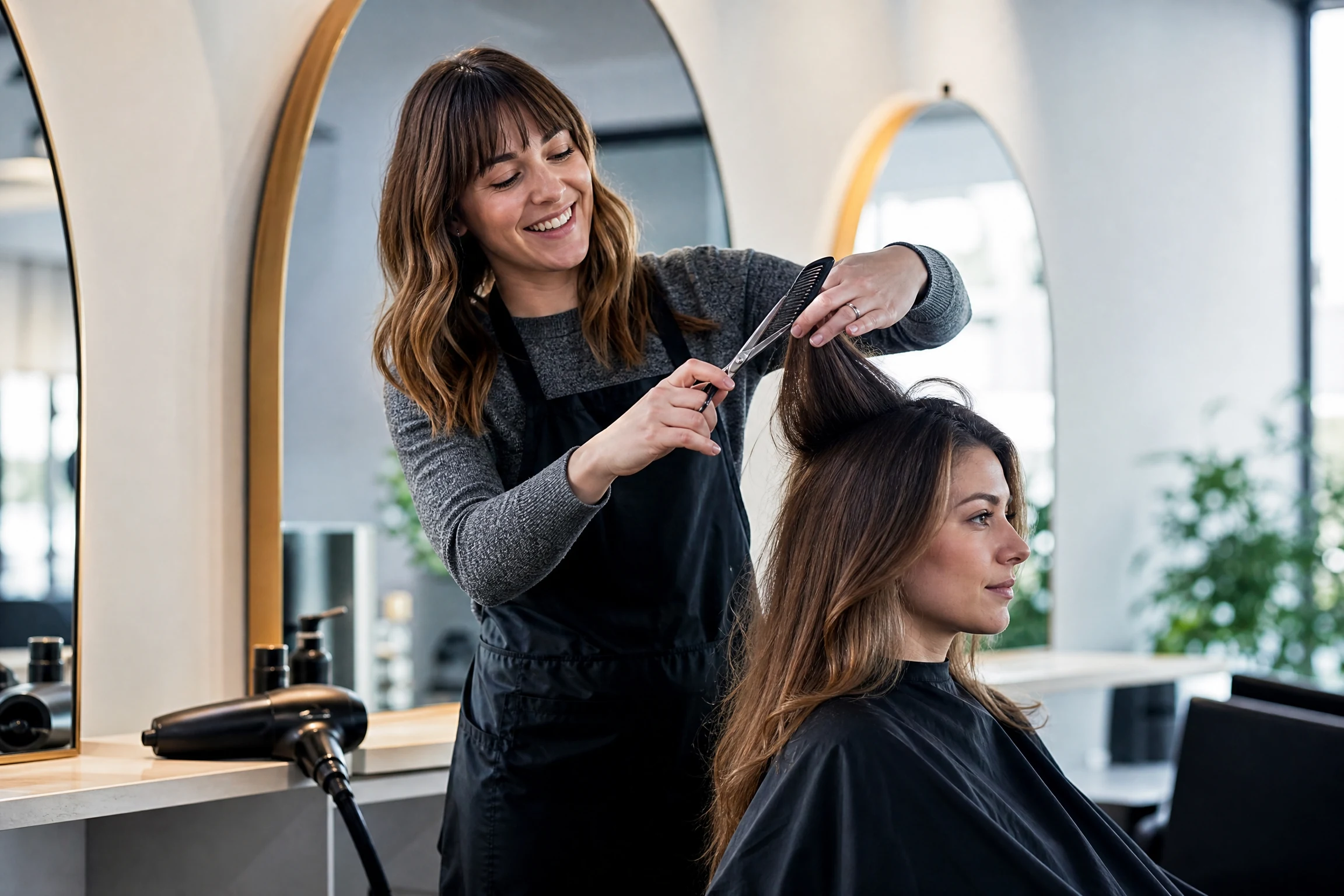
A hairdresser or hairstylist consults, washes, cuts, and styles hair, and often colours or finishes with products — then books the next visit without guessing the request.
People search for English for hairdressers, hairstylist English, salon English phrases, haircut consultation English, and hairdresser interview English. This page is chair-and-basin language. It is not the Nail Technician overview (a table and a lamp). It is not Massage Therapist. It is not a barber-only page, even though some official series group barbers with hairstylists.
US official data for this page uses BLS Barbers, Hairstylists, and Cosmetologists, with a separate wage line for hairdressers, hairstylists, and cosmetologists (SOC 39-5012). Canada uses Hairstylists and barbers (NOC 63210). The UK National Careers Service profile is Hairdresser (also hairstylist, barber). BLS notes that US states typically require a licence after an approved program and an exam. That is a US generalisation, not a global rule. Ask the employer and the local board.
What happens between the consultation and the blow-dry
The loop is listen, agree the cut, wash, cut or colour, finish, take payment, and offer a next date if they want one.
BLS describes hairstylists providing haircutting, hairstyling, and other personal-appearance services, including inspecting hair and discussing options. In a small salon you may also answer the phone. In a busy floor you take the next colour while a junior shampoos. The English skill is the same: name length, layers, and fringe in words the client can confirm, then check once more before you cut.
A photo is a starting point, not a contract. Hair density, growth pattern, and time in the chair decide what you can finish today.
What a salon job usually requires
A clear consultation and a cut you can stand behind matter more than trend vocabulary.
Consult before you cut
Length, layers, fringe, and how they wear it to work. Repeat it. “Two centimetres off, keep the fringe.”
Wash and condition if that is the service
Water temperature, product, and “is this okay on the scalp?” A silent shampoo feels careless.
Cut, colour, or style the booked service
Do not start a full colour in a 30-minute trim slot. Name the time or book the colour separately.
Check in the mirror
Show the back. Ask if the length is right while you can still take more off — or stop.
Finish and products
Name what you used if they ask. Do not invent a medical claim for a serum.
Station and book
Sweep, reset, take the next client or a walk-in honestly. Protect the person already in your chair.
Typical tasks during a salon shift
These are the spoken beats between “How are we wearing it?” and “You’re done.”
A photo consultation
Hold the phone with them. Name what matches and what will not. Wait for a yes before the first section.
A trim versus a restyle
Those are different times and prices. Confirm which one they booked.
Colour or bleach questions
Only discuss what you are trained and allowed to do here. Patch tests and processing times are house rules, not this page’s medical advice.
A client who wants more off mid-cut
Stop, show the length, confirm the new line. Do not keep cutting while they talk.
A late client
Offer a shorter service or a move. The next booking is real. Say the remaining minutes.
Shampoo-station handoff
If a junior washes, tell them the water and product in one sentence. Do not assume they heard the consult.
Till and retail
If the salon sells product, offer once. Do not pressure. Payment follows house POS.
Closing the chair
Next appointment if they want it, thank you, reset. Then look at the book, not at your phone.
Where hairdressers work
Salons, barbershops, spas, some healthcare or theatre settings, and freelance chairs. Evenings and weekends are common. Part-time work is common in the US BLS description.
The work is standing, wet, and public. You talk while you cut. You also listen over dryers. That is why short confirmed phrases beat long speeches.
This is not nail work and not massage. If a posting says cosmetologist, the employer may expect colour, makeup, or nails as well as hair. If it says hairdresser or hairstylist, expect the chair. If it says barber, expect clippers and beards. Speak2Work keeps nail technician and massage therapist as separate cards.
Salon tools and the words around them
Scissors brands change. The need to name the step does not.
Scissors and clippers
Guard numbers if you use them. “A two on the sides” is a fact. Confirm before you switch the clipper on.
Basin and hose
Temperature and pressure. Ask. A too-hot rinse is how a good cut still gets a complaint.
Dryer and irons
Heat and tension. Tell the client if a tool will be hot near the ear or neck.
Colour bowls and foils
Only if that is your service. Timing is a number you say out loud to the client or the coworker watching the clock.
Cape, clips, combs
Clean cape between clients. House laundry rules — ask. Do not invent a sanitation law.
Book and till
Service length, deposit, late cancel. Learn this salon. This page does not invent a cancellation statute.
Hairdresser English: photos, length, and a pause before the cut
You need a consultation that fits a chair and a way to stop the scissors for one second without sounding unsure.
Length in plain words
Fingers, centimetres, or “to the jaw.” Show it on their hair. Do not only point at a celebrity photo.
Layers and fringe
Name them. “Soft layers, fringe on the brow.” Guessing is how you get “I said no bangs.”
Texture and density
You can say this hair will not hold that shape without product or a shorter cut. That is professional, not rude.
Time talk
A restyle is not a trim. Say the minutes. Protect the next client.
Mirror checks
“Look at the back — is this length okay?” Wait. Then finish.
Closing
Product if they ask, next date if they want it, thank you. Then the chair is free.
Conversations in the chair
These are the moments that decide whether they book you again.
The photo will not work
Name why: too short a starting length, too tight a curl, not enough time. Offer the closest honest version.
They want a big change in a lunch slot
Book the colour or the restyle. Do the trim they have time for, or reschedule. Do not start a process you cannot finish.
A child or a nervous client
Shorter sentences. Show the tool. Ask before you turn the clipper on.
A complaint after the cape is off
Listen, show the mirror, offer what the salon actually allows: a tweak now, or a return visit. Do not cut in anger.
A coworker needs the basin
One sentence: “Two minutes.” Do not leave a client mid-rinse without telling them.
Walk-in versus book
Give a real wait. “I can take you at 3:15 for a trim.” Empty promises fill the waiting area with anger.
Where salon English is hard
The difficulty is precise length words over dryer noise, not long grammar.
Numbers and length
Two centimetres versus two inches. Confirm the unit. Show it on the hair.
Fringe, bangs, layers
Clients mix US and UK words. Point. Repeat their word plus yours if needed.
Colour names
Hold the swatch. “This one?” Do not rely on “ash” versus “gold” if the light is bad.
Licence talk
US states typically licence this work. Other places differ. Say what you hold. Do not claim a credential you do not have.
Small talk versus consultation
You can chat. You still need the cut facts before scissors. Do not let small talk replace the confirm.
Nail or spa vocabulary leaking in
This chair is hair. Do not run a manicure consult unless that is actually your job today.
Hairdresser interview English
Managers listen for the services you can do, how you consult, and whether you protect the book.
Cuts and services you offer
Name women’s, men’s, children, colour, or only what you actually do. Do not pad the list.
A consultation that changed the plan
A photo that would not work, and the honest alternative the client accepted.
A mistake you corrected
Too much off, a colour that processed fast — and how you told the client. Honesty is the professional answer.
Availability
Evenings and Saturdays are common. Answer with hours you can work.
Licence and training
Name the credential you have and that you will follow this jurisdiction. Do not treat one country’s rule as universal.
Market context
Hairdresser job-market snapshot
US employment, outlook, and openings below are the BLS combined group Barbers, Hairstylists, and Cosmetologists. The hairdresser-specific median hourly wage is listed separately. Canada’s figures are Hairstylists and barbers (NOC 63210). The UK profile is Hairdresser. Licensing rules vary. No UK pay figure is shown because this page does not treat listing-card ranges as a sourced wage series.
- $17.21 / hourMedian hourly wage for hairdressers, hairstylists, and cosmetologists
SOC 39-5012 is hairdressers, hairstylists, and cosmetologists — not barbers (SOC 39-5011), who BLS reports separately at a different median.
- $35,880Median annual wage for barbers, hairstylists, and cosmetologists (combined OOH group)
OOH quick-facts pay for the combined personal-appearance group. Hairdresser-only median hourly is listed above.
- 670,800Employment of barbers, hairstylists, and cosmetologists
Combined group. It includes barbers (about 75,800 jobs in 2025) and hairdressers, hairstylists, and cosmetologists (about 595,000). It is not nail-technician or massage employment.
- 7% growthProjected employment change for barbers, hairstylists, and cosmetologists
BLS projects about 48,400 additional jobs in the combined series. Hairdressers, hairstylists, and cosmetologists (SOC 39-5012) held about 595,000 of those jobs in 2025. It is not a forecast for every salon.
- 80,300Projected average annual openings for barbers, hairstylists, and cosmetologists
- C$19.88 / hourMedian national wage for hairstylists and barbers (NOC 63210)
NOC 63210 includes hairstylists and barbers. It is not a nail-technician or massage series.
- 441 advertised jobsJob Bank advertised openings snapshot for NOC 63210
Job Bank advertised jobs — snapshot retrieved 2026-09-10. This is not a permanent employment total.
Free Stage 1
Start Hairdresser English Stage 1
Stage 1 is free on this website: listening, vocabulary, grammar, sprint, and quiz for consultation, haircut, washing, and salon communication. Later stages stay in the Speak2Work iPhone app and are not published here.
Listening
Hear interviewer and candidate turns from a hairdresser hiring screen.
Vocabulary
Learn words for haircut, consultation, shampoo, and salon stations.
Grammar
Fill the gaps in short sentences about cuts, clients, and appointments.
Sprint
Build answers from listening phrases for hairdresser interview English.
Quiz
Answer multiple-choice questions about Hairdresser Stage 1 English.
Related English on Speak2Work
English for Nail Technicians
A manicure table and a lamp — not a haircut consultation.
English for Massage Therapists
Clinical intake and comfort language in a treatment room.
English for Cashiers
Till talk some salons also need at reception.
Hairdresser interview English
Practice answers about consultation, cuts, and the book.
Workplace English
Polite phrases you reuse with clients and coworkers.
English Guides
Short guides for work talk and interviews.
Questions about hairdresser English
What English does a hairdresser need?
You need consultation words for length, layers, and fringe, a way to confirm a photo, and a short check in the mirror. You also need time talk so a restyle does not steal the next client’s slot.
Is hairdresser English the same as nail technician English?
No. Nail English is a table, gel, and a timed hand or foot service. Hairdresser English is a chair, a basin, and a cut. Speak2Work keeps those as separate paths.
Do I need a licence to work as a hairdresser?
In the United States, BLS states that all states require barbers, hairstylists, and cosmetologists to be licensed, typically after an approved program and an exam. Other countries differ. Ask the employer and the local rule. This page is not licensing advice.
Is this the same as a barber job?
The work overlaps. Some official series group them. A barber posting may expect clippers and beards. A hairdresser posting may expect women’s cuts and colour. Read the duties. This page is salon hairdressing English.
How can I prepare for a hairdresser interview in English?
Practise describing a consultation, the services you can do, and one story about a photo that would not work. State the hours you can work, including evenings if you can.
Are there free hairdresser lessons on this website?
Yes. Stage 1 Listening, Vocabulary, Grammar, Sprint, and Quiz are free on this website. Reading and later stages stay in the Speak2Work iPhone app.
Trust
Sources and data notes
Hairdresser, hairstylist, barber, and cosmetologist overlap in ads. Official series names are kept below so a salon chair is not treated as a nail table or a massage room.
Occupational Outlook Handbook: Barbers, Hairstylists, and Cosmetologists
U.S. Bureau of Labor Statistics. Reference period: 2025–2035. Last verified: 2026-09-10.
Hairstylist wages
Government of Canada Job Bank / Labour Force Survey. Reference period: 2023–2024. Last verified: 2026-09-10.
Hairstylist market summary
Government of Canada Job Bank. Reference period: Retrieved 2026-09-10. Last verified: 2026-09-10.
Hairdresser
National Careers Service.
Practice hairdresser English
Use this overview for consultation and length language, then continue salon phrases in the Speak2Work app.